10 Seamless Line Art Vector Patterns: A Strategic Resource for Design and Brand Consistency
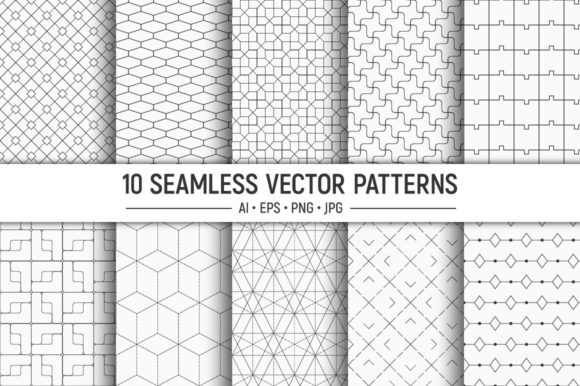
Consistency in visual identity is often what separates a memorable brand from one that fades into the background. For entrepreneurs, marketers, and creators who manage multiple touchpoints—from digital ads to physical packaging—the challenge lies in maintaining cohesion without sacrificing creativity. A well-curated set of design assets can streamline that process, and the 10 Seamless Line Art Vector Patterns collection offers exactly that kind of practical foundation. This set of geometric vector backgrounds, built around hexagons, rhombuses, dotted lines, and squares, is more than just a pack of decorative textures. It is a toolkit for intentional design, enabling professionals to build consistent visual language across diverse applications.
What makes this collection strategically useful is its versatility. Each pattern is seamless, tileable, and provided in multiple formats—AI, EPS, JPG, PNG, and transparent PNG—all at 3600x3600 pixels with 300 DPI. That level of resolution and format flexibility means you can use these patterns for both print and digital projects without compromising quality. Whether you are designing wrapping paper, fabric prints, banners, business cards, posters, or web page backdrops, the same pattern can scale and adapt. This reduces the time spent recreating elements and frees up mental bandwidth for higher-level creative decisions.
Aligning Visual Assets with Strategic Goals
Thoughtful use of seamless patterns supports broader goals such as brand positioning and customer experience. A pattern rooted in clean line art and geometric structure communicates precision, order, and professionalism. If your brand values include clarity, innovation, or minimalism, these patterns reinforce that message without needing extra explanation. For example, using a hexagon-based pattern on a business card or website background subtly signals interconnectedness and structure—ideal for tech startups, consulting firms, or educational services.
When planning a campaign or product launch, consider how a consistent pattern across materials can improve recognition. If you use the same rhombus pattern on social media graphics, product packaging, and email headers, your audience builds a subconscious link between the visual and your offering. This is not about decoration; it is about strategic repetition that strengthens memory. The 10 Seamless Line Art Vector Patterns set includes ten distinct designs, so you can assign different patterns for different product lines or seasons while keeping the overall aesthetic coherent.
Use Cases Across Roles and Industries
Different professionals will find unique value in this collection. For small business owners, the patterns can be used for wrapping paper or cloth design, creating a unified look for physical products. Educators and bloggers might use them as web page backdrops or in printable handouts to add visual interest without distracting from content. Freelancers and publishers can incorporate the textures into book covers, report layouts, or presentation slides. The key is to think of each pattern as a building block for a larger system, not just a single-use graphic.
Marketers and decision-makers often need to produce materials quickly without sacrificing quality. Having pre-made, edited, and tileable patterns in formats like AI and EPS means you can open the file, adjust colors or scale in vector software, and apply it across multiple projects. This efficiency is especially valuable when working under tight deadlines. The collection even includes one AI file and one EPS file with all ten patterns together, along with pattern swatches for easy access in design applications. This thoughtful organization reduces the friction between inspiration and execution.
Planning Your Approach to Pattern Selection
Before relying on any visual asset, it is worth evaluating how it fits your specific context. Seamless line art patterns work best when used as subtle backgrounds or accent textures, not as dominant elements. A dotted line pattern might be ideal for a scrapbook paper or stationery set, but it could overwhelm a dense infographic. Consider the balance between the pattern and your foreground content. Test the patterns on different backgrounds and screen sizes to ensure legibility and visual harmony.
Another factor is scalability. Even though each pattern comes at 3600x3600 pixels, line art details—especially dotted lines or fine rhombus shapes—may behave differently at extreme sizes. For large-format prints like banners or posters, check that the pattern tile remains crisp. The vector files (AI and EPS) allow you to edit stroke weights if needed, giving you control over how the pattern renders. This is where the strategic value of having source files and swatches becomes clear: you are not locked into a fixed version; you can adapt the pattern to your exact requirements.
Practical Examples of Intentional Use
Let’s say you are launching a new line of organic skincare products. A pattern featuring hexagons and dotted lines can evoke natural geometry and cellular structures, aligning with themes of purity and science. You could use the same pattern on the product label, the reusable fabric bag, and the brand’s website backdrop. Because the patterns are seamless and tileable, you avoid awkward seams or repetitions that feel amateurish. The transparent PNG files are particularly useful for digital mockups, allowing you to overlay patterns on photos or colored backgrounds without extra editing.
For a freelance graphic designer, the collection can serve as a resource for client work. Instead of spending hours creating a custom pattern from scratch, you can start with one of these ten designs and modify it to match a client’s brand guidelines. The included pattern swatches in design software make swapping or testing different patterns fast. This approach not only saves time but also demonstrates reliability to clients who value efficiency and consistency.
Long-Term Value and Potential Pitfalls
The long-term value of this collection lies in its repeatability. Because the patterns are digital, you can use them for an unlimited number of projects, as long as you respect the license terms. This makes it a cost-effective investment for anyone who produces visual content regularly. Over time, you can build a library of deliverables that share a consistent thread, which strengthens brand recognition and customer trust.
However, there are risks to using such assets without clear goals. Relying solely on pre-made patterns without considering brand context can lead to a generic look. If multiple businesses in your industry use similar line art patterns, your materials may blend in rather than stand out. To avoid this, use the patterns as a starting point. Adjust color schemes, combine patterns, or layer them with other textures to create a unique composition. The vector formats give you that flexibility, but only if you take the time to customize.
Another risk is overuse. A seamless pattern repeated across every piece of collateral can become monotonous. Strategic use means varying the application: use a dense pattern for small areas like business cards and a lighter version for large backgrounds. The set includes diverse shapes—squares, rhombuses, hexagons, dotted lines—so you can mix densities and styles within a single project. This variety prevents visual fatigue while maintaining a coherent system.
Decision-Making Guidance for Purchasers
When evaluating whether this collection fits your needs, consider your typical project volume and format requirements. If you frequently work with print materials that need high resolution (300 DPI), the included JPG and PNG files are ready to use. For digital work where transparency is essential, such as web overlays or app interfaces, the transparent PNG files are ideal. If you prefer to edit or scale patterns infinitely, the AI and EPS vector files give you that capability. The separate folder for each pattern and the consolidated file with all patterns make workflow organization straightforward.
It is also worth noting that this is a digital download only—no physical product ships. The mockups are not included, so you will need your own templates for presenting designs to clients or for product photography. However, because the patterns are high-resolution and tileable, you can create your own mockups quickly. This self-sufficiency aligns with the needs of independent creators and small businesses who prefer to control their production pipeline.
Integrating Patterns into a Broader Design System
To maximize the strategic benefit, think of these patterns as components of a larger design system. A design system includes colors, typography, spacing, and imagery that work together. Seamless patterns can serve as background textures, but they can also inspire other elements. For instance, the geometric shapes in the patterns could inform your iconography or layout grids. By repeating shapes and angles across all visuals, you create a cohesive ecosystem that feels intentional rather than scattered.
For long-term projects, such as building a brand from scratch, start by selecting one pattern as the primary texture. Use it consistently for key materials like the website homepage or product packaging. Then, introduce secondary patterns for supporting elements like email newsletter headers or social media frames. The collection’s ten designs give you enough variety to differentiate without losing unity. Keep track of which patterns are used where, ideally in a simple brand guideline document, to ensure consistency over time.
Realistic Workflow Tips
Begin by opening the AI or EPS file in your vector editing software. Examine the pattern swatches and test each one on a mock layout. Adjust colors to match your brand palette—line art patterns often look best in monochrome or duotone applications. For print projects, use the 300 DPI JPG files to avoid any rendering issues in layout software. For digital use, the transparent PNGs allow you to place patterns over images without background clash. Always preview the pattern at the actual size it will be used, especially for full-page backgrounds, to ensure the tile repeat is not distracting.
If you are producing scrapbook papers or printable stationery, print a test sample first. The fine details in line art patterns—especially dotted lines—can vary depending on printer resolution. Adjusting the stroke weight in the vector file before exporting can prevent loss of detail. Similarly, for web backgrounds, compress the PNG files to optimize load speed while maintaining visual fidelity. The 3600x3600px size gives you plenty of data to work with, but resizing down for web use is often necessary.
Evaluating the Full Set
The collection includes 10 AI format vector files, 10 EPS format vector files, 10 JPG files at 3600x3600px, 300 DPI, 10 PNG files at the same resolution, and 10 transparent PNG files. In addition, one combined AI file and one combined EPS file contain all 10 patterns, plus 10 pattern swatches. Each pattern resides in a separate folder, which simplifies file management. All patterns are seamless, edited, repeated, and tileable, and they come with source swatch panels. This structure is designed for professionals who need to access assets quickly and without confusion.
Understanding what is included helps you plan your usage. The separate folders allow you to hand off individual patterns to team members or clients without sharing the entire set. The combined files are useful for cataloging or for applying multiple patterns in a single document. The swatches ensure that you can reuse the pattern definition without re-importing graphic files, saving time in large projects. This attention to workflow suggests that the set was created with practical, day-to-day design challenges in mind.
When Not to Use Seamless Line Art Patterns
While versatile, these patterns are not ideal for every scenario. For highly complex or data-heavy visuals, any patterned background can reduce readability. If your primary content requires strict clarity, such as a dense chart or lengthy text, consider using the patterns as accent borders or in small header areas rather than full backdrops. Similarly, for minimalistic brands that rely on negative space, a line pattern might add unwanted noise. In such cases, the patterns are better suited for supplementary materials like packaging inserts or social media frames rather than core brand assets.
Another consideration is cultural or contextual relevance. Geometric patterns can carry different connotations depending on the audience. Hexagons might suggest science or technology, while rhombuses can evoke retro or tribal aesthetics. Always consider your target market’s perceptions. Testing patterns with a small group before wide release can prevent misinterpretation. The flexibility of the vector format allows you to tweak the pattern’s density or shape proportions to better align with your message.
Long-Term Strategic Outlook
Investing in a set like this is not just about immediate design needs. Over the long term, having a reliable library of seamless patterns reduces reliance on outside designers for basic texture creation. It also allows you to maintain visual consistency even as your team grows or as you outsource work. By using the same patterns across multiple channels, you reinforce brand recognition and build a cohesive customer experience. For solopreneurs and small teams, this self-sufficiency is a significant advantage.
As trends evolve, line art and geometric patterns remain relatively timeless compared to more stylized graphics. The clean, structured aesthetic tends to age well, making it a prudent choice for brands that want to avoid frequent redesigns. However, periodic updates to your color palette or pattern combinations can keep the look fresh without abandoning the core design system. The capability to edit vector files makes these updates straightforward.
Finally, remember that design assets are tools, not solutions. The 10 Seamless Line Art Vector Patterns collection can simplify your workflow and elevate your projects, but its impact depends on how thoughtfully you integrate it into your overall strategy. Use it with clear intent, customize where necessary, and let the patterns serve your goals rather than dictate them. This approach will ensure that your designs remain both beautiful and effective, project after project.
For creators who value efficiency, consistency, and quality, this collection offers a practical foundation. Whether you are preparing digital printable paper, planning a product launch, or refreshing your brand identity, the patterns provide a reliable starting point. Explore the possibilities, test the boundaries, and build a visual language that works for your specific context.