6 Seamless Square Patterns for Versatile Design Projects
Patterns are among the most foundational elements in visual design. They bring texture, rhythm, and personality to surfaces that might otherwise feel flat or forgettable. What makes a pattern truly useful, though, is its ability to repeat without interruption. A design that breaks at the edges or feels disjointed after a single tile quickly loses its professional polish. That is where the idea of a seamless square pattern becomes essential. Whether you are building a brand identity, decorating a digital space, or preparing print materials, having access to a cohesive set of 6 Seamless Square Patterns can save hours of manual work and open up new creative directions.
This article walks through what these patterns actually offer, how they behave across different media, and who tends to get the most value from them. It also covers practical strengths, limitations you might encounter, and ways to evaluate whether a given set fits your specific project. By the end, you should have a clear sense of how to incorporate such a collection into your own workflow, whether you are a seasoned professional or someone just starting to explore pattern design.
What Makes a Seamless Square Pattern Different
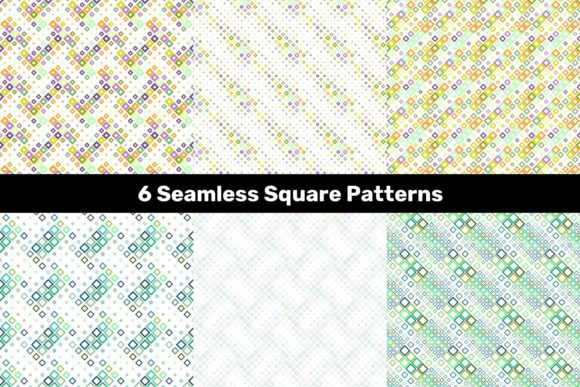
A seamless pattern is essentially a tile that can be repeated infinitely in any direction without showing visible seams or breaks. The square format is particularly common because it aligns naturally with grids, tiles, and screen layouts. When designers talk about 6 Seamless Square Patterns, they are referring to a curated set of six distinct tileable designs, each contained within a square canvas. The seamless property is not just a convenience; it fundamentally changes how the pattern can be used. Without seams, the pattern flows across large areas—whether a wallpaper span, a fabric roll, or a website background—without distracting interruptions.
The collection format, typically offered as a package, adds value beyond individual files. You get multiple coordinated or thematically related patterns at once, which allows for mixing and matching across a project. For example, one pattern might serve as a primary background while another works as an accent element or border treatment. Having six options in a single set gives you flexibility without requiring you to source each design separately.
Contents of a Typical Pattern Package
A well-prepared pattern package usually includes several file formats so you can use the designs across different tools and output types. The set referenced here contains:
- 6 JPG files at 5000x5000 pixels – High-resolution raster images suitable for digital use and most print applications up to large formats.
- 6 vector .EPS files – Encapsulated PostScript files that retain sharpness at any size, ideal for professional illustration and layout software.
- 6 vector .AI files – Native Adobe Illustrator files that allow direct editing of paths, colors, and elements within the pattern.
The 5000x5000 resolution is notably generous. At 300 DPI, that translates to roughly 16.7 by 16.7 inches of print coverage from a single tile. For digital use, that resolution covers retina displays and large monitors without visible pixelation. The vector formats, meanwhile, ensure you can scale the patterns down to a tiny icon or up to a billboard without any loss of quality, and you can recolor or modify individual components as your project evolves.
Who Benefits from Having 6 Seamless Square Patterns
The audience for pattern sets is broader than many people assume. While graphic designers and illustrators are obvious primary users, the practical reach extends into several other fields.
Digital Content Creators
Bloggers, social media managers, and video producers often need backgrounds that look intentional without being distracting. A seamless square pattern can serve as a subtle texture behind text overlays, a vibrant backdrop for product shots, or a repeating element in motion graphics. Because the pattern is seamless, it loops cleanly in video or animation without a visible jump at the tile boundary.
Business Owners and Brand Managers
Brand consistency relies heavily on visual repetition. A set of 6 Seamless Square Patterns can become part of a brand toolkit, used across packaging, stationery, website headers, and trade show materials. When patterns are available in both raster and vector formats, adapting them to different media becomes straightforward. For a small business owner without a dedicated design team, having ready-made patterns reduces the need to commission custom artwork for every application.
Print-on-Demand and Product Designers
Anyone creating merchandise—t-shirts, phone cases, mugs, tote bags, or home decor items—can use patterns to differentiate their products. Seamless designs ensure the pattern wraps around cylindrical objects or repeats across fabric without awkward gaps. The 5000x5000 JPG files are particularly useful here because print-on-demand platforms often require high-resolution uploads, and the vector files allow for precise color adjustments to match a specific product palette.
Architects and Interior Designers
Even professionals working in physical spaces find value in digital pattern collections. Visualizing wallpaper, tile layouts, curtain fabrics, or upholstery samples often involves digital mockups before any physical material is ordered. Having a set of patterns in vector format means you can quickly test different scales and color variations in your rendering software without starting from scratch.
Real-World Applications and Practical Scenarios
To make the concept more concrete, consider a few scenarios where 6 Seamless Square Patterns could be directly applied.
Scenario one: An independent author self-publishing a series of books wants a cohesive look across covers, chapter headers, and promotional graphics. By selecting one pattern from the set as the primary cover texture and a complementary pattern for interior page accents, the author creates a unified visual system without hiring a designer for each element. The high-resolution JPGs ensure print quality, while the vector files allow the author to tweak colors to match each book's mood.
Scenario two: A social media manager handling multiple client accounts needs fresh, on-brand backgrounds for weekly posts. Rather than sourcing new images every time, they rotate through the six patterns, adjusting overlay text colors to match each brand's guidelines. The seamless nature means the pattern tiles perfectly across Instagram Stories, Facebook banners, and LinkedIn headers, regardless of the device or screen size.
Scenario three: A surface pattern designer building a portfolio uses the vector files to study how the patterns were constructed—examining the arrangement of motifs, the spacing logic, and the color distribution. This reverse-engineering process helps them improve their own pattern-building skills. The same files can be used as a starting point for derivative designs, where elements are swapped or recolored to create entirely new compositions.
Strengths of Working with Pattern Packages
There are clear advantages to using a pre-made set of 6 Seamless Square Patterns rather than creating each design from scratch or collecting single files from disparate sources.
- Time efficiency. A single project can require multiple pattern variations for different sections or formats. Having six ready-to-use designs eliminates the need to design each one individually, which can take hours or even days depending on complexity.
- Format flexibility. The combination of JPG, EPS, and AI files means you are covered whether you work entirely in raster-based tools, vector-heavy software, or a mix of both. You do not have to convert formats and risk quality loss.
- Resolution headroom. The 5000x5000 pixel size provides substantial room for cropping, scaling down, or printing large without interpolation artifacts. For comparison, many stock pattern files are offered at 2000 or 3000 pixels, which can limit large-format use.
- Editability in vector. The AI and EPS files allow you to change colors, remove elements, or combine parts of different patterns. This is harder to do with raster-only files, where you would have to manually clone and heal areas.
- Coordinated variety. Because the six patterns come as a set, they typically share a coherent aesthetic or thematic connection. This makes it easier to use multiple patterns in a single project without clashing styles.
Limitations and Considerations to Keep in Mind
As useful as these pattern sets are, they are not a universal solution. Understanding their limitations helps you avoid frustration and choose the right approach for your work.
File size and performance. A 5000x5000 pixel JPG at high quality can be several megabytes large. Using such files directly in web design without optimization can slow page load times. For web use, you may need to compress the JPGs or generate smaller scaled copies. The vector files, while resolution-independent, can also be computationally heavy if they contain many complex curves, especially in older software.
Pattern repetition visibility. Even though the tile is seamless, some patterns exhibit a noticeable repeat when applied over large areas, particularly if the motif is large or the tile is very distinct. When used at a small scale, this is rarely an issue, but on wall-sized prints or wide website backgrounds, the repetition pattern may become visually dominant. Testing at your intended scale before committing is always a good practice.
Limited customization in raster. The JPG files are essentially flat images. You cannot easily change a single color or remove one element without editing the entire tile. If you need significant modifications, the vector files are the better starting point. If you are not comfortable working with vector software, this limitation may affect your ability to tailor the pattern.
Aesthetic fit. A pre-made set of 6 Seamless Square Patterns is designed with a particular style or theme in mind. It may not suit every brand or project. If your visual identity is very specific, you might need a custom pattern that matches exact colors, motifs, or cultural references. Pre-made sets work best when you have some flexibility in your design direction.
How to Evaluate a Pattern Set for Your Needs
Before purchasing or downloading a pattern package, consider a few evaluation criteria that can save you time and ensure the set actually serves your project.
Check the pattern scale. Look for a preview that shows the tile at a real-world size. Some patterns look great as a small swatch but become repetitive or chaotic when scaled up. If the provider shows the tile repeated several times, that gives you a better sense of the overall visual rhythm.
Verify file compatibility. Make sure your software supports the formats included. EPS and AI files have version compatibilities, so if you are using an older or non-Adobe application, you may need to convert files. The JPG files are universally readable, so you will always have a fallback.
Assess color versatility. If the set uses very bold or specific colors, it may be harder to adapt to different branding. Neutral or muted patterns tend to be more versatile across projects. Vector files mitigate this because you can recolor them, but that requires time and skill.
Consider the number of patterns. Six is a good middle ground. Too few patterns limit your options; too many can be overwhelming or redundant. With six, you have enough variety for most small to medium projects without sacrificing curation quality.
Final Thoughts on Using Pattern Packages
A collection of 6 Seamless Square Patterns is a practical asset for anyone who works regularly with visual content. The combination of high-resolution raster files and fully editable vector files gives you the freedom to use the designs across nearly any medium, from digital screens to large-format print. The seamless property removes the most common headache in pattern use—visible tile edges—so your backgrounds look professional and intentional.
That said, the real value lies in how you integrate these patterns into your workflow. They work best when treated as a starting point rather than a final answer. Experiment with scale, color, and layering. Combine patterns with textures, gradients, or typography. Let the patterns serve as a foundation that you customize to fit the unique contours of each project. With the right approach, even a single set of six patterns can support a wide range of creative outcomes without demanding the time and effort required to build each pattern from the ground up.